I am a musician, and more than in most professions, it is essential that musicians have a hobby. Fishing is mine. My ‘chosen’ profession was thrust on me really, rather than chosen, as I wasn’t much good at anything else.
Angling and being a musician are activities one has really to throw oneself into. As Elgar said, ‘Music is all around us’, and for anglers, so is water. It is quite an indulgent pastime, and while indulging, we can forget nearly every other problem, like tax and wondering where the damp behind the wallpaper is coming from. I have spent many of my best moments sitting on the riverbank watching and listening to moving water. An example of white noise, this life-giving element sounds different to each person. The sound of water can be more beneficial when experienced in the countryside, as other sounds, such as the wind soughing in the trees and birdsong, are often an accompaniment. If one lets that sound wash over one in a mindful way, it can be refreshing in a most relaxing, stress-free, and satisfying way, especially when the soul is being besieged by problems elsewhere.
I am told that the game of golf has a similar revivifying effect on people intent on lowering their handicap, who often spend hundreds on that new-design of two-iron only to give them an extra five yards reach into the heavy unplayable rough. In my youth, I played a little at Northenden Golf Club, discovering quite soon that it was, in fact, all golf clubs that were my handicap.
Everyone needs to be able to relax. It is particularly annoying for musicians to have their attention disturbed when they are trying to concentrate on their job. For instance, there was a bass player standing just behind me in the pit, who was in the habit of gently but audibly humming along with me during the horn solo in the Mendelssohn Nocturne. I didn’t want to complain just in case I played a wrong note while he hummed the right one at the same time. We, like everyone else, mix with interesting people in the normal run of things and like being able to ‘switch off’ when not thinking about our work. There are not many days we can do so. Not at the weekends, or Christmas and New Year’s Eve, maybe, but at odd times, like, occasionally, Tuesday evening or part of Friday morning or when a concert has to be cancelled because of deep snow in winter.
Unwanted intrusions into our professional lives do happen at parties. I don’t go to them these days, mainly for that reason. Still, in the past, during the process of tasting the warm Algerian White and wondering what they’d put in the sausage rolls, I was occasionally told how romantic it was to spend one’s existence travelling the world playing great music in a great orchestra. We often get a question – as all musicians know – ‘What do you find to do the rest of the day?’ This is a common fantasy in the minds of the great British Public when in partying mood and well known to orchestral musicians. I cannot speak for parties in other nations.
On the subject of the romance of music-making and the joys of travel, finding what used to be called ‘theatrical digs’ was not without its dangers. On occasion, when booking into a B&B, I have glanced at the visitors’ book and noticed a sometimes well-drawn but often rather crude picture of a raven (‘Nevermore, quoth the raven’) drawn alongside the name of a recent disgruntled guest.
The ‘Romance of the Job’ is the one conversation dreaded by musicians as it forces them to tell the truth, to the astonishment of the other person who thinks one is simply being cynical – which, occasionally, one is, of course. One time I countered this by avoiding any comment and instead grilled the speaker in question, an architect, for twenty minutes with questions on the merits of the different box-girder bridge designs he had known. I am told that judges have similar trouble on their day off, having to address putative litigants found on the aforementioned golf course when they would much rather prefer to be addressing the ball.
I was told about a doctor who was nobbled at a party by an elderly man with back pain, and who was forced to advise him at some length on some suitable treatment. After he had impatiently cured his partying patient, he complained bitterly to a lawyer in the corner of the room about this interference into his leisure time. The lawyer, having tucked his left hand professionally into his jacket (which itself should have warned the doctor) sympathised, advising him to put these types off permanently by the next day, sending the annoyance a bill for his services. Word would soon get around, and he would have no more trouble at parties. The doctor followed the lawyer’s advice, and of course, two days later, received a heavy bill for the lawyer’s counsel.
But one can usually escape these intrusions on the river, while carefully tying on – with a half-blood, or Turle knot of course – a ‘Pale Watery’ or ‘Lunn’s Particular’ or, if one is desperate, a ‘flying condom’ (truly) onto the line. Of course, these days, one can also reduce the chance of intrusion into one’s reveries by at least turning one’s phone off just in case there is the likelihood of a signal in the vicinity. There was the story – just after those early and bulky cell phones had been introduced – of the young Edinburgh Stock Exchange stockbroker, having a day on a remote loch, whose phone suddenly rang. The grizzled ghillie who was in charge of the boat’s oars listened in awe for five minutes to loud and impassioned exclamations of ‘Buy!’ and ‘Sell!’ disturbing the peace of the machair. When the trader rang off, he asked whether he could have a look at the ‘contraption’. ‘Och, I’ve dropped it,’ he said, with only the barely discernible hint of a twinkle in the eyes of his 12-year-old Balvenie-sozzled face, as it slid from his hands and into the depths.
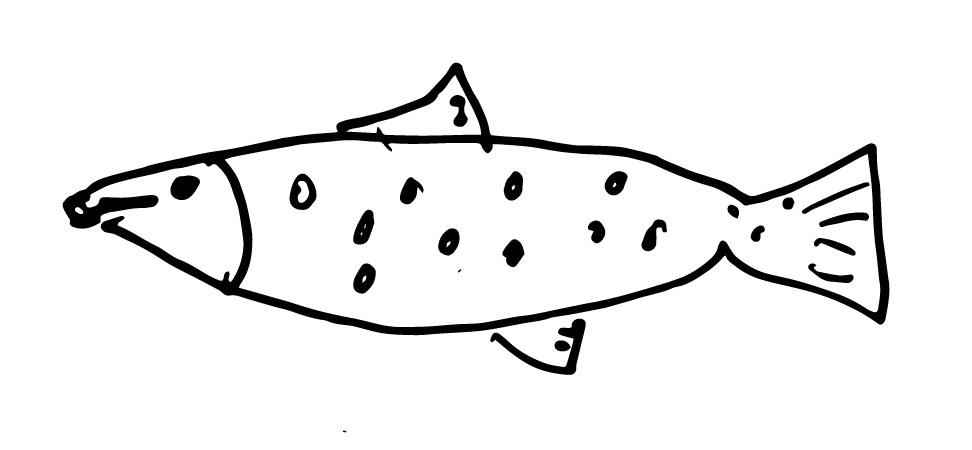
One early summer some years ago, and before cell phones were invented, I had a day off work and was fishing on the River Itchen a short distance from St Catherine’s Hill, near Winchester. It was near the end of May, and the weather had been perfect all day. Izaak Walton, of whom I may speak later, lies buried in St John’s chapel in Winchester Cathedral. I can prove this as I have a photo of my be-cassocked son holding his French horn while standing on Walton’s memorial stone.
This was this time of year when, like as the hart (as the psalmist has it), I often desired the water-brooks. In May and June, the big fish rise to that large annual miracle of nature, the mayfly, through whose wings the rays of the afternoon sun pick out every vein, and, in the imaginative, might give the impression even of ‘pointing to something beyond’. It makes one marvel at a wonder of nature that a mayfly can spend two years at the bottom of the river and then, after swimming to the surface, have just one or possibly two days to fulfil its destiny. It firstly changes its clothes into something glorious. Then, deciding against this outfit changes them again into something even more resplendent. It spends a little time searching for and succumbing to its mate’s charms before finally dropping back onto the water exhausted and either sinking to the bottom or being eaten by a fish or a swift. The females are lucky if they can deposit their eggs on the surface, and luckier still if a percentage of these can survive to live at the bottom of the river for two years and rise again as nymphs, for the cycle to repeat itself.
It is no wonder that the romance of nature and of procreation encouraged Shakespeare and his contemporaries metaphorically to use the word ‘die’ in so many of their plays and poetry. We fly-fishers relish the wonder and romance of the three or four weeks by the river before and after the beginning of June. Everything is youthfully alive, even, briefly, the mayflies. The kingcups and musk orchids are spread across the field near the water, the butterflies and hover flies are gathering their pollen, and you can ‘hear a snail clearing its throat a mile away’. Everywhere, in other words, it is summer. I had discovered fishing, and the best things about this magical time of year at school, not entirely coincidentally – because it was the summer term – failing the great majority of my ‘O’ Levels at the same time.
The warm sun is one thing. But anglers don’t want it too hot anyway. Any more than fish do who sulk in too much heat. Don’t we all? The thing of which we remind ourselves is that on a chalk stream such as the Itchen, the deliciously cool water in the stream, on which the fish thrive, results from six months’ dripping and filtration through the chalk before it bubbles up clear and refreshing from springs the base of the hill. It is this water upon which we are trying to land our fly in a particular spot and with feather-like precision.
As it emerges from the base of the Downs, the filtered water forms itself into tiny rivulets that converge and become busier and bigger as they flow through the four southern counties of Hampshire, Wiltshire, Berkshire and Dorset. The purity of the nutrient-rich alkaline stream irrigates the fertile wild-flower meadows, such as the one in which I was sitting. The size of the fish in the chalk streams is legendary over the world, except, perhaps in New Zealand, where they grow even larger. I once ‘lost’ (“No man can lose what he never had”, Isaak Walton – discuss) a fish on a lake on the South Island, which I swear was over 5 pounds in weight. One day, I must tell you the story of the one-armed fisherman describing the size of his catch to a passer-by.
There is a smaller area of chalk stream fishing in East Yorkshire, The Driffield Beck, that is equally valued. It is of particular interest for this story, though, in that the chalk downs actually spread themselves – even under the English Channel. They emerge again near Caen in France, and over there, the equally sparkling rivers like the shallow Risle, the Charentonne, and the Andelle are revealed.
Although practiced over many decades, my skill with a dry fly has always been somewhat limited. As with horn playing, one never stops learning and is frequently challenged. But on the Itchen that day, by using the right fly at the right time of day, I had been lucky. Lucky enough to have caught two trout of more than average size by midday, as well as a handsome grayling. I had seen the outline of this third fish in the water and knew it was a grayling as soon as it rose with that particularly curious athletic backward movement just behind where it lay. At around lunchtime, I was sitting on the riverbank, two fish in my bag, for I had returned the grayling to live another day. I was eating my sandwiches and drinking the bottle of beer that I had cooled in the stream.
For a few minutes I had been considering whether I would have had as good or even better luck on my other favourite river, the little river Wye up in Derbyshire that I had by then been fishing each year, getting on for forty years, beginning while I was working in Manchester. I wondered why this thought had come to me until my eye fell again on my brass bottle opener with its horn-shaped handle. This implement that I always carried in my fishing bag is what we musicians, no doubt, as astrophysicists, Polynesian pearl fishers and brain surgeons on their days off, too, call the chapel key.
On the surface, orchestras are these days more abstemious than hitherto, and indulgence in the demon drink is quite rightly frowned upon by the management. I’m absolutely sure that there is no more drinking in the music business than there is in any other profession, but there is a standing joke trotted out by some bystanders, when – talking to brass players – they come out with the old saw; ‘I bet taking all those deep breaths is thirsty work, isn’t it?’ I am not sure what a deep breath has in common with alcoholic liquid. Nonetheless, in some orchestras, even mature self-restraint on behalf of a player has been of little account if a less than enlightened management assumes the worst after a miscalculation somewhere in the orchestral ranks. Largely gone are the days when the pub was an automatic refuge for ‘a few quick ones’ and a sandwich during a break in a day that comprised a rehearsal and, two hours later, a concert.
Talking of the demon drink, however, it is not only overindulging in ‘sucking at the bung’, as Peter Warlock so nicely puts it in one of his sociable songs, but that is also now discouraged either. When I was young, in the days when people came to the door selling polishing cloths and boot polish and washing pegs, and the more polite used to apologise when someone bumped into them. Every one of the 70,00 spectators at Old Trafford would wear either a flat cap or a trilby – orchestral players would smoke throughout the rehearsal, something rightly forbidden now (the Royal Opera House burned down twice, in 1808 and 1858). Up to the 1960s, one would marvel, during the languid slow movement of a symphony, at the string of ash from the cigarette in the mouth of a violinist gradually becoming elongated until it would gently drop through the f-hole of the instrument during a subsequent exciting passage. I supped and lit my pipe as I pondered these matters. It is a well-known fact that all grandfathers, as I am now, used to smoke pipes. And now, just as they now don’t, I also used to and now don’t, either.
It must be said that horn players who fish – and there are a few – look keenly in their diaries to see the next free day. Sensitive and keen horn players feel guilty being on the river when they should by rights be practising for their next appearance on the platform. But the physically necessarily must be balanced against the mentally beneficial. Just how meticulous I had ever been about practising, I am not sure, but that was all irrelevant now, sitting there in the sun, with only the hubbub of the butterflies in an adjoining meadow to disturb my peace. Looking at my bottle opener, my mind briefly returned, not to the remembrance of past fishing heroes and failed exams, but to an event that had occurred several years before. It always happened when I saw the chapel key, and I can’t imagine ever throwing it away. Maybe we need objects around us that will remind us of some good past events, hoping they will engender more in the future.
After finishing my beer, I got to my feet and walked upstream, hoping to hear the ‘plop’ of a healthy rise, knowing that this was an unlikely event until the evening, when things sometimes went mad on the water. With this in mind, I knew I would soon have to leave it until the next time.
After some fruitless peregrinations up to the end of the beat and back, I looked at my watch. The bell ringers were doing their Friday pre-choir practice early evening work-out in the old church tower nearby. I remember thinking that from their sound; they seemed to need the practice. One hundred years before, the famous trout fisherman and solicitor G.E.M. Skues had also timed the end of his fishing day – on a stretch of the river nearby at Abbot’s Barton – by means of the clock on his nearby church telling him that he had twenty minutes to pack up his tackle and stroll across the fields to the station halt for his train back to London where he lived. Where I was standing was a magical place. Being a nondriver, I would also soon need to get back into Winchester on the ‘bus. During the Great War, Skues would offer a day’s fishing to an officer on leave. I believe that he later called those days the ’14-18’ disturbances. Thinking of packing up shook me out of my water-meadow-induced reverie.
I have introduced this gentle story in this manner quite deliberately, and the ending, too, is much bound up with my love of trout fishing. But for one simple event and its aftermath, the tale will seem merely a nostalgic trip down memory lane. Nevertheless, having absorbed the conscious thread of wistfulness running through this memoir, I trust you will realise the extent to which, when I thought about the chapel key, the events that had occurred many years before had affected me. If its full impact on me is to be understood, it will merely demonstrate how good things can come in pairs.
If you have not the slightest interest in the sport of trout fishing, the small percentage of what follows that is essentially nothing to do with the sport will not be sufficient to attract your attention to the rest of the story that has led up to it. I therefore humbly suggest that you get the general drift at the beginning and then skip to the end. But I think it worth the risk for the few who may want to read on if I put into context a pleasantly gentle sequence of events, if only as an instance of something that one encounters when one least expects it.
We must go back to a similar summer’s morning twenty-one years before this. Seven is a significant number for me, and twenty-one is thrice seven. I had started my first job on the 10th of January, my second on the same day seven years later, and my third would begin on the same day of the month exactly seven years after that.
In my mind, I was back in Manchester, in the ‘bus shelter in Piccadilly, getting my breath back from practically running with my fishing tackle to the bus station after the rehearsal, with my toothbrush and thermos flask in my fishing bag.
I needed to board the 6.15pm coach to Bakewell, a quite small but bustling town in the Derbyshire Peak District boasting two churches, sundry antique shops, and a market to lure in unwary tourists in the summer months. And, importantly, it contained a river. I do not remember why I first decided to fish this river – mainly because it was well known and relatively close to work; I suppose. I know I was twenty-one when I did so originally and never regret discovering it.
A similar, rather later ‘bus back the next evening would ensure I was not late for work on the Wednesday. Although I managed no practice during my day off, I always tried – although unconvincingly – to tell myself we were allowed to have days off. I had had a similar dilemma at school, choosing between fishing and revising my irregular verbs, as I have already recounted. I was a callow youth and somewhat insecure at the time, having somehow crept via the back door into the French horn section of a famous orchestra in Manchester when I was only twenty. I think I invented the words ‘Impostor Syndrome’. The day in question had consisted of rehearsals until half-past five, and the next was free for fishing.
I was on what one might call the horns of a dilemma in those days. I needed to practise as much as I could to keep up my playing. Still, I also took every opportunity to refresh my casting skills (even more limited in those days than now) by buying a day ticket on the renowned little limestone river, the Wye, a stream that, like the Itchen was beloved of Izaak Walton. Maybe that was why I was drawn to it. I would get to my usual cheap hotel at about 8 pm, just in time for supper.
By this time, these cheap overnight stays were becoming a bit of a habit. I would return to my flat the following day and the next morning pick up my instrument that I had left in the band room, in plenty of time for a little revivifying warm-up before the next rehearsal.
What I shall relate occurred about 4 or 5 years after I had started fishing this little Derbyshire river. I was becoming used to its twists and turns and thought I would soon know nearly every inch of the riverbank, which was, in fact, eventually more or less the case.
The following morning after a night in the hotel, I would always wait outside the rather Ye Olde-style Bakewell pudding shop until they opened, buy a delicious medium-sized example, and then a pork pie of similar dimension in the butchers nearby. Then, armed with my flask, kindly filled with tea in the hotel kitchen and my rod, net and fishing bag, and remembered toothbrush, I would stroll beyond the edge of the town and past the houses to a spot half a mile below. I always considered this part of the river where the ticket allowed me to fish to be an area full of places with alternating runs and small pools to try out my casting. By now, I was used to certain beats on which I had more luck than others. All-in-all there were, in fact, about three or four miles of fishing to choose from, and I would cast until the late afternoon, then walk back to get the last ‘bus back to Manchester that night.
This river Wye must not be mistaken for its larger cousin, the Welsh Wye, rising a couple of miles away from its friend the Severn in Plynlimon, up in the Cambrian mountains. Our little river is well known for two main reasons. One was that, as I have stated, Izaak Walton, the hero of every fly fisherman, is reputed to have fished the river three hundred years ago, and what was good enough for him should be good enough for me. I am always susceptible to ‘atmosphere’ and would imagine him wearing his big hat, fishing ‘fine and far off’ – not difficult with the very long fishing pole he used. The other reason for the river’s renown is that, although not a wide river or not very long, it is one of the very few – I believe the River Chess is another – streams that hold a stock of both wild rainbow and brown trout that co-exist quite happily. Unusually, the rainbows, originally imported from South America, are self-sustaining and need no assistance from man in procreating.
As a matter of interest, this particular part of the northwest is remarkable for its aforementioned limestone rock, which can give a blueish tinge to the otherwise clear water in the river’s upper reaches. The mineral content of the water influences the nature of the vegetation, aquatic invertebrates, and the like on which the fishes’ food thrives. The fighting quality and size of the fish are equal to those on the chalk stream rivers in the south of the country. It is not a strict rule, but this type of water demands the angler use some different kinds of fishing flies from those we employ on Southern rivers to tempt fish that have particular feeding habits.
In the hotel, I was told that a Frenchman had booked in for three days’ fishing as well. I met him in the bar. He was dark-haired and probably only in his late thirties. Tall and distinguished-looking, I immediately thought how Gallic and charming he was. His demeanour was thoughtful, but as soon as he was introduced to me as a fellow pêcheur, he became quite animated. He seemed pleased to meet me and keen to talk. We sat up late in the lounge, having embarked on a long chat about the sport and the river in particular, as this was his first visit. He had long wished to fish the same waters as Izaak Walton and said he liked everything English, especially the girls and even some of the food. He seemed pleased that I could describe which my experience had told me over the previous few years were the most likely spots in which he would have some luck. As the conversation developed and his knowledge and fishing experience became clear, it soon became obvious that the word luck had no place in his dictionary. I was looking forward to learning from him.
My French was of the just barely passed A-level variety. A local bassoon player of my acquaintance had conducted the ‘oral’ part and was entirely on the subject of food, which was lucky. Owing to reasons already outlined, I was relieved that my new French friend could express himself so well in English, albeit with his regional accent. I learned a lot as he described his favourite rivers in northern France.
I only knew these French streams by reputation. They had been fished by the great and the good; Ernest Hemingway, Charles Ritz – even Churchill. My new friend, M. Gautrot, mentioned perhaps one of the most famous personalities who had fished these waters. The lady in question, Odette, was the wife – and eventual owner – of the son of the founder of the famous Champagne house of Pol Roger. She was herself, in fact, English. Once, in her eighties, she could sometimes be seen very early in the morning in mid-stream fishing the Andelle, delicately casting a dry fly to the trout. She was still dressed from the night before in a ball gown, its folds voluminously spread out over the water behind her. I had often dreamed about making a trip to Normandy and was now – In the bar parlour of the hotel – having the privilege of talking to one who knew the streams, and stories associated with them, intimately. The extraordinary thing is that I remember so much of the conversation as if it were yesterday. Adolphe – for that was his name – happened to mention that he was soon having to move to a new position in Paris on behalf of his firm and would be forced to restrict his chalk stream fishing to the holidays.
Being used to these Normandy chalk streams, but not our limestone waters, Adolphe had already done some research in the town’s local fishing shop, just up a side street by the hotel, as soon as he had checked in. He said that he knew, as I did, that ‘local knowledge’ was always de rigeur when fishing a strange river, and I was flattered when he asked even me which fly I would find effective on the river this time of year.
He then talked a little about the native grayling found in most, but not all, French trout streams. As we have seen in later years near Winchester, I would continue my acquaintance with these beautiful ‘Ladies of the Stream’ with their outsize dorsal fin standing up like a sail. They bear the delightful Latin name Thymallus Thymallus (you can smell thyme for a few seconds after you have lifted them from the water).
He was also keen to seek out our indigenous rainbow trout. The brown trout in the chalk streams of Normandy nearly always contain a population of completely wild fish and can grow to enormous proportions, and it impressed him that our rainbows were wild fish as well. Those rainbow trout of his native Norman rivers were mainly escapees from fish farms, and I assured him that ours were there to be had, and though the river rarely held many fish of over two pounds, they always fought well right up to the net.
Over supper that evening, he had shown me the contents of his fly-box. It contained only dry flies and nymphs, most of them smaller than I was used to. Nymphs are fished beneath the surface of the water and ‘worked’ by the angler by pulling sharply on the line every few seconds to give these small artificial creatures a semblance of jerky movement as they swam or often darted to the surface before hatching into fully formed flies. Not all nymphs act in the same way, and I think it pleased him that I already had some knowledge of the habits of these different creatures as they found their way to the surface of the stream. There is much nymph fishing in France, and my new friend’s fly tin contained many different patterns, tied mainly by himself. Tying flies was something I was not adept at, although I had tried with only limited success when I was young. Also, he showed me the representation of the dry patterns he had tied and those he had purchased a few hours before, round the corner. All trout fishermen own a few fly-boxes more than they require, which are full of dozens of patterns accumulated over the years.
Interestingly, one expert angler, the famous baritone Harry Plunket Greene, who died in 1936, fished with only one dry fly his whole life, the Iron Blue. He was a first-class fisherman and never blamed the fly for his failures – but always his own skill. He was possibly this country’s most famous interpreter of Schubert lieder, and all horn players should include a copy of Interpretation in Song on their bookshelves. On his grave in Hurstbourne Priors lies an aluminium fly-box with long-ago rusted flies still within.
Adolphe Gautrot’s own patterns were delightful examples of the fly-tyer’s art, sparsely hackled for the most part, and as I say, tied on smaller hooks than I was used to. Designed to float on the surface, dry flies are always made with the feathers of cock birds, making the hackle water-resistant, standing up stiffly in the surface tension. ‘Wet’ flies always use hen hackles, tied to slope back down the shank of the hook, something which makes them sink beneath the current and present an alternative attraction to the fish. Wet flies, covered in considerably more hackle than are nymphs, were strictly prohibited on this particular river as their use was considered, by some, ‘unsporting’, just as is the use of the F-alto instrument in some quarters.
Just by his conversation, I discovered that like many Frenchmen (and incidentally Belgians also), he was an expert angler. He said that he had not fished a limestone stream before, which was why he had bought suitable dry flies – including some ‘Pale Wateries’ which are always a good pattern – from the local shop. I left him to go to my room.
We had arranged to meet for an early breakfast. I had pointed out how to reach the river, and I told him I would get to the shops for our lunch. Over the late meal that evening, my new friend had tucked into the Bakewell pudding with gusto, so I had the menu organised.
He appeared to have made a bit of a hit with the waitress at breakfast. She was trying to offer him more sausages, although she was having trouble with ‘Monsieur’ and so they settled on ‘Adolphe’. He refused the foreign sausages, even though it was evident to me they had clearly come from highly contented pigs. She was very attentive, and, even over the short period of the breakfast service, I remember thinking at the time that he was also not unaware of her charms.
Having served more coffee, we resumed our talk about where we would fish that day. We both had maps of the fishing and after pointing out the likely spots, we both agreed to start at each end of the beat and work our way up and down to where we would meet at a barn set back from the water to consume our lunch. Adolphe said he ought to tie some more flies that I had recommended, so we fixed the spot on the map to convene. I said au revoir, paid my bill, and left for the water via the pudding shop.
I had a reasonably successful morning and anticipated showing my new friend my fish – two rainbows and one brown – and discovering whether he’d had luck with his flies.
I admit to being disappointed to find that he was not at our designated meeting place at 1 pm, the appointed hour. I particularly regretted not having a further chance to pick his brains on casting techniques and fishing generally. I ate and drank my lunch. I mused for a while on the meaning of life while resisting eating his pudding and my excuses for doing so should we meet later. Eventually, I continued onto the other half of the water. But he did not appear, so although I’d caught fish and the sun was out, it was with mixed emotions I packed up my tackle.
I reached the ‘bus stop near the roundabout outside the hotel just in time to climb on. I was curious about what had happened to my new friend but had no time to inquire at the hotel. And so, I returned, slightly frustrated, but with fish for the freezer at home. Life went on.
Over twenty years later, I found myself in Paris, booked to play seventh horn in an otherwise stellar horn section, in Mahler’s First Symphony in Cité de la Musique. The horns were all playing ‘echt’ Vienna instruments that night. Although I could not by any stretch of the imagination described as any sort of expert on the instrument, mine is a fine Uhlmann model, once owned by Alan Civil and was admired by others in the section that tried it. As all of us who fish and play the horn, of course, know, when casting an efficient fly, we like to keep our casting hand ‘in’ whenever we get the opportunity (right-handed in my case). But oddly, they also know that when playing that particular model of horn, it is a different kettle of fish. English players, brought up in the ‘English’ style – which may or may not actually exist – must think counter-intuitively. They need to remember to keep their right hand out. Of the bell, that is. This is so that they play ‘â la mode typiquement Viennoise’, as someone of my limited language skills might say when, as a Shropshire lad, he is discussing Austrian horn-playing in a Parisian angling shop.
As soon as I had got off the ‘bus from the airport and had checked into the hotel, I made my way to my favourite fishing shop on the Île de la Cité. I walked in and looked again in amazement at the fishing equipment there. I bought some beautiful (size 20 and even smaller) dry flies and a small old-fashioned wicker creel that I could not resist. Then my eye caught sight of the horn-shaped brass bottle-opener lying under a glass case. After I had paid for that and my other purchases, the shop bell tinkled, and another customer walked in. I looked up, and of course, who else could it be but Adolphe Gautrot, whom the shop proprietor addressed by name. We didn’t speak for a moment as recognition dawned. Then he said, ‘I had your address from the hotel and then lost it! I wanted to explain!’. We were very pleased to see each other again, and he went on to say that he had indeed caught some fine rainbows that, and the next day. It turned out that letter and postcard writing had unavoidably detained him and by his fly tying. By the time he had reached the river well after midday, he had started fishing on the beat I had been on in the morning. So, that was why I had missed him.
I assured him that all was forgiven. I told him what I was doing in Paris and that there was a concert the next night, and he promised he would be there. I remember how much, at lunch with the section after the rehearsal the next day, I enjoyed my first spoonful of a delectably creamy cauliflower-cheese soup, tastefully decorated with a tiny white floret at its centre.
When I saw him and his wife after the concert, I was very impressed with how perfect her French accent, albeit with faintly detectable Derbyshire overtones, was.